A World Prepared for Life: Coincidence or a Sign of a Creator?
Earth is not habitable because of one lucky feature. It sits within a wider convergence of water, orbit, atmosphere, chemistry, protection, and cosmic order that invites a deeper question about purpose and creation.
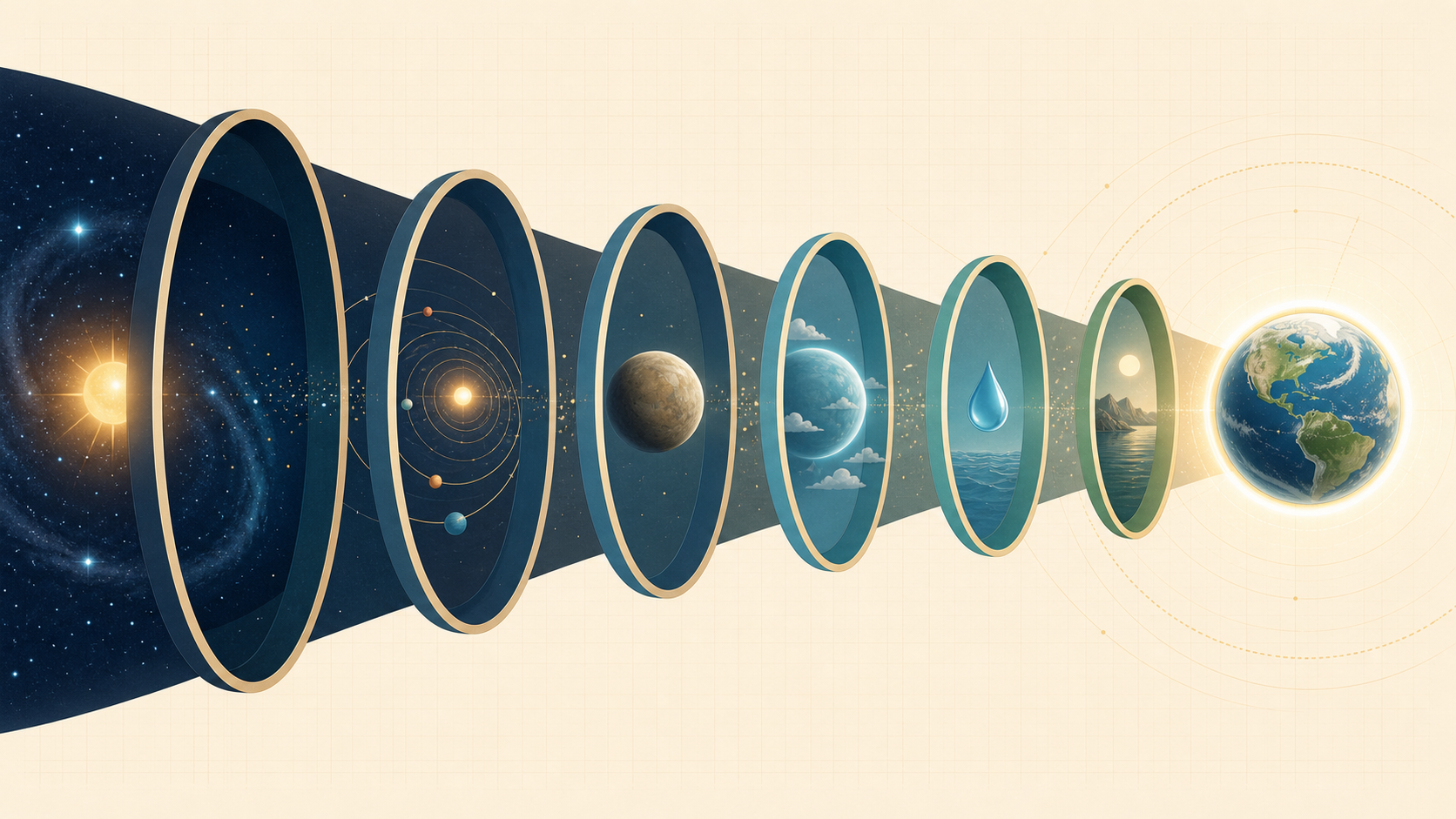
Earth appears small against the scale of the universe, yet it contains oceans, a life-supporting atmosphere, usable energy, complex chemistry, and living beings able to reflect on their own existence. Life depends not on one favorable condition, but on many conditions arriving together. What should we make of that convergence?
The right place around the right kind of star
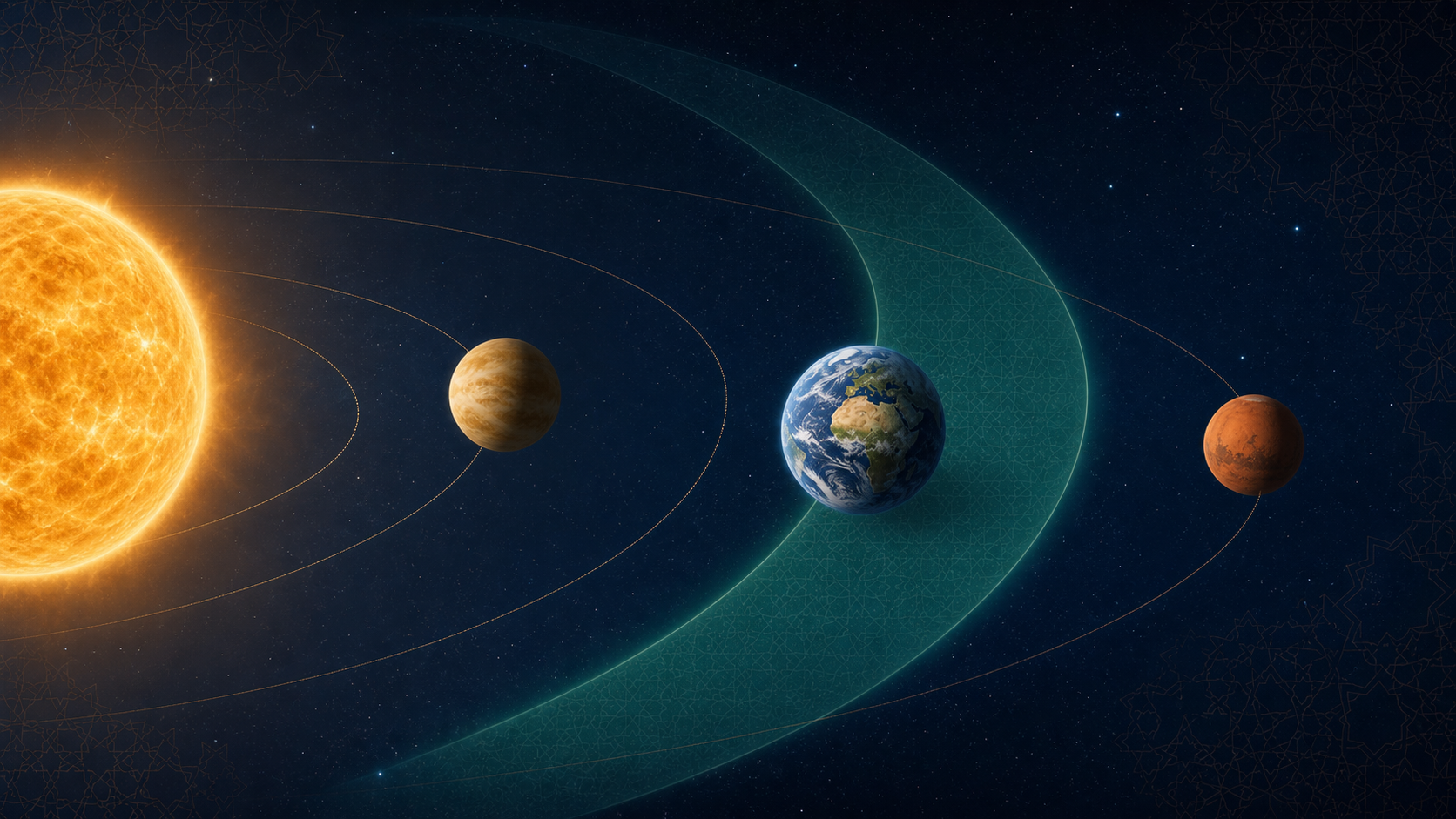
Earth orbits within the Sun's habitable zone, often called the Goldilocks zone: the range of distances where surface temperatures may allow liquid water, provided the planet also has a suitable atmosphere. Too close and surface water may be lost to extreme heat; too far and widespread surface water may freeze.
But location is only a first filter. NASA emphasizes that a planet's size, atmosphere, temperature, and the behavior of its star also matter. Mars lies near the outer part of our Sun's present-day habitable zone, yet its thin atmosphere and cold surface do not support oceans today. A place in the zone makes habitability possible; it does not make life inevitable.
A planet rich in liquid water
Every known form of life depends on liquid water. Water carries dissolved materials, participates in cellular chemistry, distributes heat, and supplies an environment in which biological reactions can occur. Earth does not merely contain traces of water: oceans cover most of its surface, while water circulates through the atmosphere, soil, ice, rivers, organisms, and underground reservoirs.
The resemblance is therefore best offered as a point of reflection about the Quran’s repeated attention to land and sea—not as a mathematical proof. A sound argument for creation should not depend on a word count that changes with the counting method.
Did the unbelievers (who do not accept the teaching of the Prophet) not realize that the heavens and the earth were one solid mass, then We tore them apart, and We made every living being out of water? Will they, then, not believe (that We created all this)?
An atmosphere, climate, and shield
Earth's atmosphere performs several tasks together. It supplies pressure that permits surface water to remain liquid, moderates temperature, carries gases used by life, and filters some harmful radiation. Its climate is neither permanently frozen nor trapped in a Venus-like runaway greenhouse state.
Earth's magnetic field adds another layer of protection. It deflects much of the charged solar wind and can help protect an atmosphere from erosion. Beneath our feet, a dynamic planetary interior contributes to this magnetic field and to long-term geological cycles. Habitability is not a single feature sitting on Earth's surface; it is an interacting planetary system.
The universe had to permit life before Earth could host it
Long before oceans or cells could exist, the universe needed stable matter, long-lived stars, usable chemistry, and physical laws that allowed galaxies and planets to form. Stars had to manufacture and distribute elements such as carbon and oxygen. Fundamental parameters had to permit complex structures rather than a universe that expanded too quickly for galaxies to form or collapsed before life had time to develop.
Scientific discussions call this fine-tuning: the observation that some laws, constants, and initial conditions occupy ranges compatible with complex, embodied life. Scientists and philosophers disagree about its ultimate explanation. Proposed accounts include deeper physical necessity, observational selection within a multiverse, brute fact, and intentional design.
We have created everything in a determined measure.
What can probability honestly tell us?
We cannot responsibly multiply real-looking percentages for each condition unless we know their probability distributions and dependencies. We do not yet know how often life begins when conditions are suitable, how many different environments can support unfamiliar forms of life, or how frequently the relevant planetary conditions occur together.
We can, however, use a hypothetical model to understand the logic of compounding requirements. Suppose—purely for illustration—that five independent requirements each occurred on one planet in ten:
- 1A long-lived and sufficiently stable star: assumed 1 in 10.
- 2A rocky planet in a suitable orbit: assumed 1 in 10.
- 3A life-compatible atmosphere and climate: assumed 1 in 10.
- 4Persistent liquid water and usable chemistry: assumed 1 in 10.
- 5Long-term stability sufficient for complex life: assumed 1 in 10.
Under those invented assumptions, and only if the conditions were independent, the combined fraction would be 1/10 × 1/10 × 1/10 × 1/10 × 1/10 = 1 in 100,000. Change the assumptions and the answer changes. The value is not an estimate of life in the universe; it is a teaching example showing why several filters can narrow possibilities quickly.
Chance, necessity, selection, or purpose?
Calling something 'chance' may describe our lack of a further explanation, but it does not itself explain why the possible outcomes, laws, or probability structure exist. Physical necessity would be powerful if a deeper theory showed that the life-permitting conditions could not have been otherwise, but no established theory currently settles every fine-tuning question. A multiverse may broaden the number of trials, yet it also raises questions about the mechanism generating universes and the laws governing that mechanism.
Intentional creation offers a different kind of explanation. A rational Creator would not be surprised to produce an ordered and intelligible reality capable of life, consciousness, moral responsibility, and knowledge. This is a philosophical inference, not a result measured by a telescope. It should be evaluated alongside the alternatives rather than disguised as a laboratory proof.
The Quran asks us to look—and look again
Surely in the creation of the heavens and the earth, and in the alternation of night and day, there are signs for men of understanding.
those who remember Allah while standing, sitting or (reclining) on their backs, and reflect in the creation of the heavens and the earth, (saying): 'Our Lord! You have not created this in vain. Glory to You! Save us, then, from the chastisement of the Fire.
In the retrieved translation, reflection on creation is joined to the conclusion that it is not without purpose. This article's comparison between that Quranic invitation and modern habitability research is a contemplative synthesis; it is not a claim that the verses teach a specific astrophysical model.
(To guide) those who use their reason (to this Truth) there are many Signs in the structure of the heavens and the earth, in the constant alternation of night and day, in the vessels which speed across the sea carrying goods that are of profit to people, in the water which Allah sends down from the sky and thereby quickens the earth after it was dead, and disperse over it all manner of animals, and in the changing courses of the winds and the clouds pressed into service between heaven and earth.
Who created the seven heavens one upon another. You will see no incongruity in the Merciful One's creation. Turn your vision again, can you see any flaw?
Then turn your vision again, and then again; in the end your vision will come back to you, worn out and frustrated.
Conclusion
A habitable world is more than a lucky address.
Earth's orbit matters, but so do its water, atmosphere, chemistry, protective systems, geological history, stable energy source, and the deeper laws that permit planets and life to exist. We cannot convert all of this into one honest, universally accepted probability. We can recognize that the convergence calls for explanation.
Science describes the conditions with growing precision. Reason asks why such an ordered, life-permitting reality exists. The Quran invites us to see that order as a sign rather than pass it by without reflection.
Scientific and Quranic sources
- NASA Science, ‘What is the Habitable Zone or Goldilocks Zone?’ Used for the definition and limits of the habitable-zone concept. Source
- NASA Science, ‘Can We Find Life?’ Used for additional planetary and stellar requirements beyond orbital distance. Source
- NASA Science, ‘Beginnings: Life on Our World and Others.’ Used for liquid water and life-as-we-know-it framing. Source
- NASA Science, ‘Earth-like Exoplanets May Have Magnetic Fields Capable of Protecting Life.’ Used for magnetic-field and atmospheric-protection context. Source
- Luke A. Barnes, ‘The Fine-Tuning of the Universe for Intelligent Life.’ Review of scientific fine-tuning literature. Source
- Fred C. Adams, ‘The Degree of Fine-Tuning in our Universe—and Others.’ Review of constraints on life-permitting constants and parameters. Source
- Quran 2:164 in Sayyid Abul A'la Maududi's Tafhim al-Quran translation, retrieved through quran.ai. Source
- Quran 3:190–191 in Sayyid Abul A'la Maududi's Tafhim al-Quran translation, retrieved through quran.ai. Source
- Quran 21:30 in Sayyid Abul A'la Maududi's Tafhim al-Quran translation, retrieved through quran.ai. Source
- Quran 54:49 and 67:3–4 in Sayyid Abul A'la Maududi's Tafhim al-Quran translation, retrieved through quran.ai. Source